Short Line and Regional Railroads are the lifeblood of the North American supply chain, moving 40% of US carloads and providing the “first and last mile” critical to the economy. But in 2026, the stakes have never been higher. With increasing FRA (Federal Railroad Administration) oversight, evolving Transport Canada safety mandates, and a persistent labor gap, “paper-and-clipboard” operations are no longer just inefficient, they are a liability.
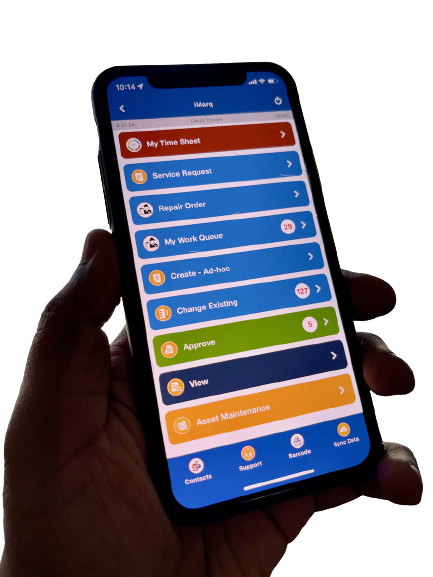
Connixt iMarq is a mobile-first, cloud-native solution purpose-built to digitize the complexities of track, signal, and rolling stock maintenance.



Short lines often operate in “dark territory” with zero cellular connectivity. iMarq’s native app for iOS and Android allows crews to complete inspections and work orders offline, syncing automatically the moment they return to a signal area.
Digitize your walking inspections. Capture high-resolution photos of defects, geotag locations via GPS, and use LiDAR scanning for precise measurements of gauge and cross-level—all from a standard mobile device.
Data is only as good as the insights it provides. Our AI assistant, iBot, analyzes historical inspection data to predict component failures before they cause a derailment or service interruption.
“iBot, show me all switches in the North Yard that have required more than three adjustments in the last 6 months.”

| Feature | Legacy Paper-Based Process | Connixt iMarq (Digital Standard) |
| Data Integrity | Illegible handwriting, “desk-top” inspections, and lost clipboards. | Time-stamped, GPS-tagged entries with mandatory photo evidence. |
| Audit Readiness | Days of manual filing and “scrambling” when the FRA inspector arrives. | Instant Audit Mode: Generate 49 CFR-compliant PDFs in seconds. |
| Field Intelligence | Technicians rely on memory or outdated paper manuals. | iBot AI Assistant: Real-time access to manuals, asset history, and repair tips. |
| Defect Lifecycle | Delay between finding a defect and creating a work order. | Auto-Trigger: Critical defects automatically spawn high-priority work orders. |
| Dark Territory | No access to data until the crew returns to the yard. | Offline-First: Syncs data seamlessly via satellite or cellular when available. |
| Asset Longevity | Reactive “run-to-failure” maintenance model. | Predictive: Uses 2026 data analytics to identify wear trends before failure. |

Utilize your smartphone’s LiDAR and AR capabilities to measure rail wear, joint gaps, and tie condition. Every measurement is logged against a Linear Referencing System (LRS), allowing for a digital twin of your entire track network.
Moving beyond “satisfactory” vs. “unsatisfactory,” iMarq captures granular data on the health of your infrastructure:
Rail & Joints: Monitor for cracked joint bars, loose bolts, and rail end mismatch. Use mobile LiDAR to detect head wear and vertical/lateral deformation.
Ties & Ballast: Log “effective” vs. “defective” tie counts per segment. Track ballast fouling, drainage obstructions, and vegetation encroachment that violates sightline regulations.
Turnouts & Switches: Detailed measurements of point thickness, switch-rail fit, and heel-block integrity.
Special Features: Dedicated modules for Level Crossings (flangeways, signage, and surface condition) and Bridge Structures (Part 237 compliance).
Streamline your Inbound/Outbound inspections. Use speech-to-text to record car defects while keeping your hands free and your eyes on the equipment. iMarq handles everything from “bad order” tagging to the final release for service.
Keep your fleet moving and avoid “Bad Order” bottlenecks with streamlined mechanical inspections:
Freight Car Safety: Comprehensive walk-around checklists covering wheels (flat spots, thin flanges), axles, couplers, and side-frames.
Brake Systems: Automated logging of Class I, IA, II, and III Brake Tests. Capture piston travel measurements and air pressure readings directly in the field.
Locomotive Daily Inspections: Ensure 49 CFR Part 229 compliance with digital logs for cab safety, fire extinguishers, emergency equipment, and fluid levels.
Manage the heavy documentation required for FRA Part 236 (Signals) and Part 237 (Bridges). Upload underwater inspection photos, structural reports, and signal test results into a single, secure cloud repository.
Signal failures are a leading cause of service interruptions. iMarq ensures preventative maintenance is rigorous:
Crossing Warning Systems: Quarterly and annual test logs for lights, gates, and bells.
Relay & Battery Maintenance: Log voltage readings and battery discharge rates to identify aging components before they fail.
Insulated Joints & Impedance Bonds: Track the electrical integrity of track circuits to prevent “phantom” occupancy indications.
Identifying a problem is only half the battle. iMarq manages the entire lifecycle of a railroad repair.
| Asset Category | Critical Maintenance Actions Tracked |
| Track | Rail grinding schedules, tie replacement programs, and surfacing/tamping logs. |
| Vegetation | Herbicide application records (including wind speed and chemical mix for environmental compliance). |
| Lubrication | Automated reminders for wayside lubricator refilling and blade adjustments. |
| Wheels | Trending of wheel wear data to predict when a car needs to be pulled for a wheel-set change-out. |
Inspector Mike starts his day at the yard office. Instead of hunting for a paper manifest, he opens the iMarq app on his ruggedized tablet.
Sync & Prep: While still on the office Wi-Fi, the app syncs his assigned territory for the day.
Safety First: Before he can access his route, Mike completes a mandatory Job Safety Briefing (JSB) directly in the app, acknowledging current weather conditions and “foul of track” safety protocols. His digital signature is timestamped and geolocated for the compliance record.
Mike is now 20 miles out in a remote cut with zero cellular service.
Offline Mastery: Because iMarq is offline-native, Mike continues his FRA Part 213 walking inspection without interruption.
LiDAR Precision: He notices a potential gauge issue. Using the tablet’s integrated LiDAR scanner via iMarq, he captures a sub-millimeter accurate measurement of the rail head. The app instantly compares this against regulatory thresholds and flags it as a “Non-Critical Defect.”
At a turnout, Mike identifies a chipped switch point.
Hands-Free Reporting: With his gloves still on, Mike uses Speech-to-Text to dictate his findings: “Switch 42B, East Siding. Significant spalling on the point rail. Recommend replacement within 30 days.”
Visual Evidence: He snaps three high-res photos. Using the in-app annotation tool, he circles the specific area of concern in red, ensuring the repair crew knows exactly what to look for.
Mike marks the defect as “Urgent.”
Instant Trigger: The moment Mike’s tablet catches a signal, the system doesn’t just “store” the data—it automatically generates a Work Order in the back-office EAM (like SAP or Maximo).
Predictive Alert: Back at HQ, the iBot AI notices this is the third defect at this specific switch in two years and alerts the Roadmaster to investigate a possible subgrade issue.
Mike finishes his patrol and hits “Complete.”
The Paperwork is Already Done: The system instantly compiles his day’s work into a formatted, FRA-compliant PDF. No more hours spent back at the office manually typing up field notes.
Total Visibility: His supervisor receives a notification that the daily inspection is complete, including a map-view overlay of exactly where Mike traveled and every asset he touched.
| The Problem | The iMarq Solution |
| “He said, she said” | Immutable audit trails with GPS and photos prove the work was done. |
| Pencil Whipping | Mandatory field validation ensures inspectors are physically at the asset. |
| Compliance Gaps | Automated alerts for missed inspections or expiring certifications. |
| Legacy Tech | A modern interface that older “non-techy” crews actually enjoy using. |
Eliminate the risk of “desk-top” inspections and manual filing errors. iMarq automates the workflows for:
Part 213 (Track Safety Standards): Capture geometry, tie condition, and drainage issues with GPS-stamped evidence.
Part 215 (Freight Car Safety): Streamline inbound/outbound inspections with automated “bad order” notifications.
Part 236 (Signal & Train Control): Manage the rigorous testing schedules for relays, switches, and crossing warnings.
Part 243 (Training & Qualifications): Ensure only qualified personnel perform safety-critical tasks via digital credential verification.
Meet the latest standards effective as of January 2026, including:
Updated Track Safety Rules (TSR): Support for the newest inspection and maintenance requirements.
Railway Locomotive Inspection and Safety Rules: Standardized digital reporting for roll-away protection and locomotive design standards.
SMS (Safety Management Systems): A unified platform to log incidents, fatigue management, and risk mitigations, moving away from fragmented paper systems.
Transitioning to iMarq isn’t just a safety move; it’s a financial one.
CRISI Grant Alignment: Many CRISI (Consolidated Rail Infrastructure and Safety Improvements) grants specifically prioritize projects that implement safety technology. iMarq provides the data evidence required for successful grant applications.
Reduced Insurance Premiums: By providing insurers with an immutable record of proactive maintenance, Short Lines can negotiate better rates in a hardening insurance market.
In the Short Line world, budgets are tight. iMarq doesn’t just help you fix what’s broken today; it helps you plan for tomorrow.
Heat Mapping: Visualize “Hot Spots” on your line where defects occur most frequently. Is it a subgrade issue? A drainage problem? iMarq shows you the where and the why.
Tonnage Tracking: Correlate maintenance frequency with MGT (Million Gross Tons) to justify capital expenditures or CRISI grant applications for rail replacement.


RELAM, a leading provider of rail maintenance equipment and services, streamlined its field operations by adopting Connixt iMarq. By moving from paper-based processes to mobile, digital workflows, RELAM achieved over 90% technician adoption, reduced equipment downtime, improved inventory visibility, and significantly cut paper use.
The result: faster, more efficient maintenance and better decision-making across teams.
Locate rail assets, work sites, and crew in real time. Crews can view assigned tasks on a map, mark exact defect locations, and navigate to remote inspection points with ease.
Create, assign, and manage maintenance work orders for tracks, switches, signals, bridges, and equipment. Crews receive all job details instantly—on any mobile device.
Technicians can capture photos of defects or completed work and add annotations directly on the image. This helps supervisors review, approve, and archive visual records easily.
Field crews can log notes hands-free—even with gloves on. Just speak into the device to document issues, inspection findings, or comments while on the move.
Automatically prioritize and organize tasks by urgency, location, or asset type. Work queues help dispatchers and supervisors stay ahead of critical repairs and inspections.
Ensure every inspection and repair follows the right procedure. Connixt helps you meet FRA and internal compliance standards—with digital logs, checklists, and signatures.
Access real-time dashboards and reports to track maintenance status, inspection performance, and open work orders. Make better decisions with clear, up-to-date data.
Built-in approval workflows for completed jobs, safety checks, or materials used. Supervisors can approve from anywhere—no need to wait or chase paperwork.
Track spare parts and inventory across your rail yards and depots. Link materials to work orders, manage restocks, and monitor usage—all from one place.
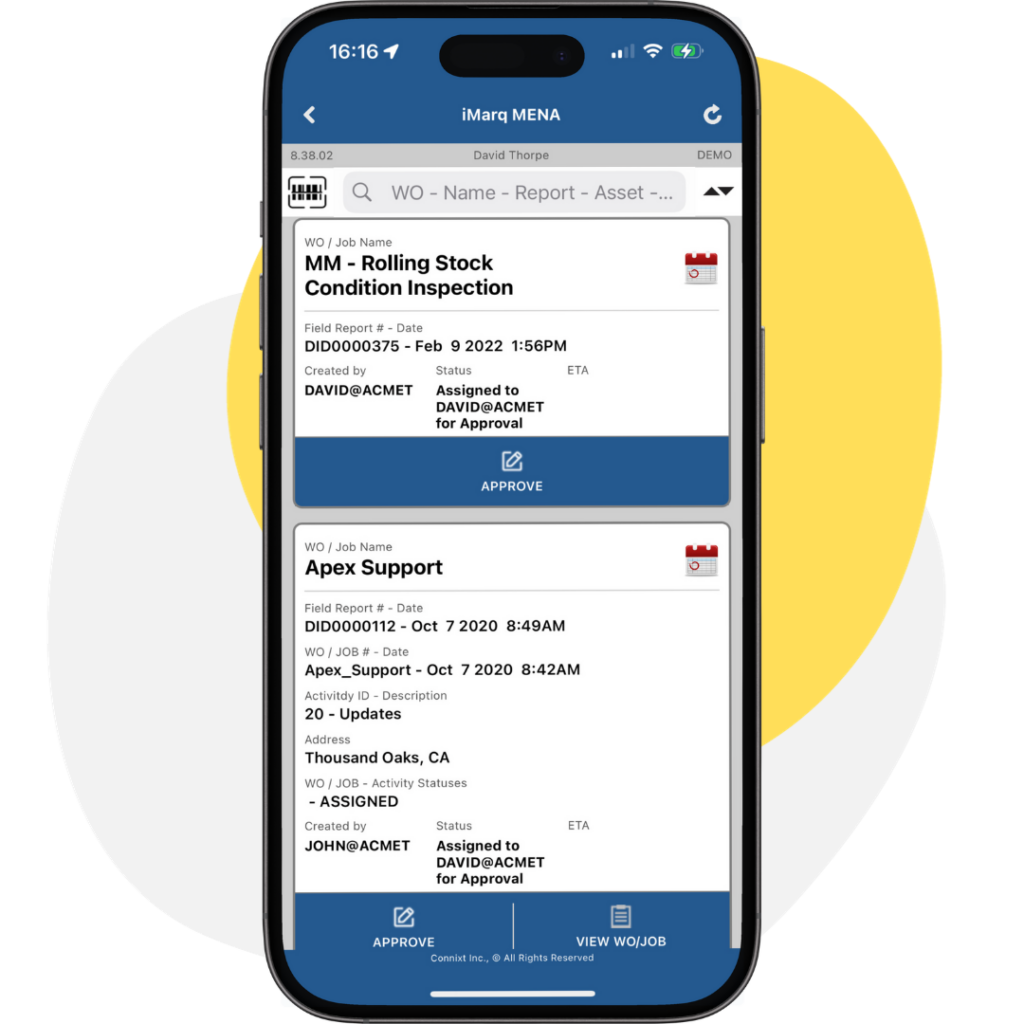
Unlock significant returns in every aspect of your maintenance process
Seamlessly deploy iMarq to your crew, ensuring minimal disruption to your day-to-day operations
Go up to 95% paperless with iMarq!
So user-friendly that your crew will embrace it effortlessly, without the need for any training.
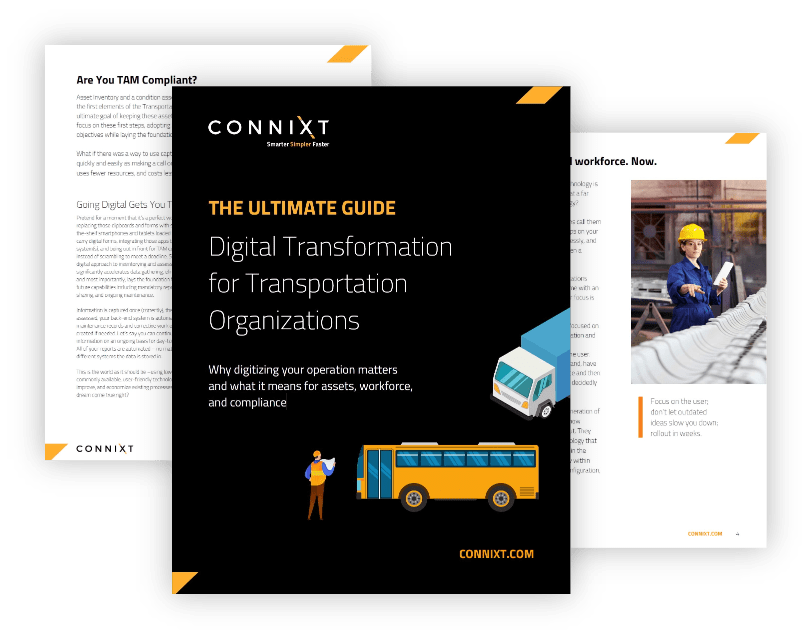
Whether your organization is quick to adopt technology or not, our e-book is a great primer on how organizations in the transportation industry should be thinking about the growth and plans.