Isaac Fleet Management Software gives fleets powerful telematics, ELD compliance, and DVIR capabilities, so a defect or a fault code rarely goes unnoticed at the moment it happens. The harder question has always been what happens next. Too often, it’s a phone call to the shop, a paper form, a work order created manually sometime later, with no reliable way to track resolution, no record of the time or parts a repair actually consumed, and a CMMS or EAM that has no idea any work was performed at all. Then an audit comes around, and someone is stuck reconstructing a paper trail instead of pulling one up.
iMarq now integrates directly with Isaac Instruments telematics to close that gap. When a driver logs a DVIR defect or a fault code fires automatically, the information doesn’t just sit inside Isaac waiting for someone to notice and act on it. It becomes a tracked, assigned work order the moment it’s flagged.
How It Works
The integration runs as a genuine closed loop, from the moment a defect is detected to the moment it’s resolved and confirmed. It starts with the driver. Every major ELD platform, including Isaac, supports DVIR, so pre- and post-trip inspections are already being logged there, with any defects or fault codes flagged in real time alongside the vehicle’s exact GPS location.
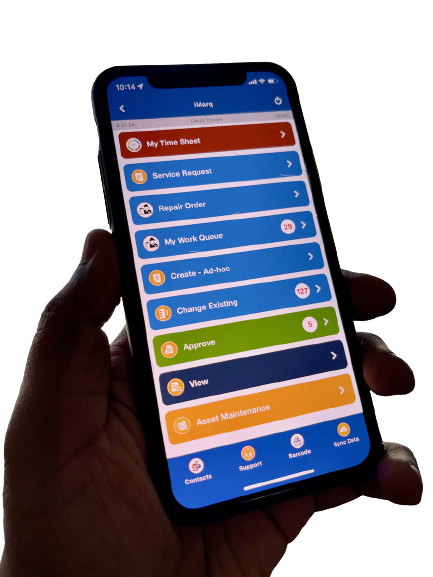
From there, iMarq picks up automatically. Defects, repair codes, odometer readings, and alerts coming out of Isaac instantly generate a work order in iMarq, complete with the vehicle’s location attached, and it lands directly on a technician’s phone. No dispatcher has to relay the information, no paper form has to change hands.
The technician then completes the repair in iMarq itself, capturing labor, parts, photos, and sign-offs as the work happens rather than reconstructing it afterward. That completion record updates the fleet’s backend system automatically, whether that’s Trimble TMT, Maximo, SAP, or another CMMS, EAM, or ERP already in place. Finally, the loop closes: completion status syncs back to Isaac, the driver can see their reported defect has been resolved, and managers are left with a full audit trail rather than a pile of paperwork to sort through after the fact.
What the Closed Loop Delivers
The most immediate benefit is that no defect goes untracked. Every fault flagged in Isaac creates a corresponding record in iMarq, so nothing gets lost in a handoff, forgotten on a sticky note, or left open without a resolution. Every issue ends up with a work order, an owner, and a status.
It also changes the experience for drivers, not just technicians. When a driver flags a defect, they know it’s been received, assigned, and resolved, without needing to follow up with the shop themselves to find out what happened to it. That visibility reduces friction and builds trust between the cab and the maintenance team, which matters just as much for morale as it does for uptime.
Compliance reporting becomes a matter of pulling a report rather than reconstructing one. Every DVIR defect, every repair, and every sign-off is timestamped and linked automatically, so a DOT inspection or an internal audit stops being a scramble through old paperwork and becomes something the system can produce on demand.
And because the vehicle’s GPS location is captured automatically the moment a defect is logged in Isaac, dispatch always knows exactly where a truck is, which matters most in the moments it matters most: a roadside breakdown, a mobile repair decision, a call about where to send help.
Why It Matters
Isaac tells a fleet what’s happening with its vehicles. A CMMS or EAM, whether that’s Trimble TMT, Maximo, SAP, or something else, holds the maintenance history, parts inventory, and compliance records that fleet depends on. But without a bridge between the two, telematics data stays stuck in the operations silo, and maintenance stays reactive by default, responding to problems instead of anticipating them.
iMarq is that bridge. Mileage from Isaac automatically advances preventive maintenance schedules. Hours of service data triggers time-based service intervals, keeping them accurate regardless of how a route varies week to week. Fault codes become prioritized work orders, coded to VMRS standards for DOT compliance. And every completion flows back in the other direction, updating Isaac, the backend CMMS or EAM, and the fleet’s compliance record all at the same time, so nothing has to be reconciled by hand later.
Where iMarq Fits
The Isaac integration runs on iMarq’s core maintenance engine, the same platform that already handles mobile work orders, digital inspections, field approvals and e-signatures, incident reporting, timesheets, parts requests, and preventive maintenance scheduling for field teams. It’s one of three major additions in the iMarq Summer ’26 Release, alongside a new Tires module for per-position tire lifecycle tracking and Pinpoint, iBot’s new AI-powered document lookup.
Learn more about the Summer 2026 Release: www.connixt.com/imarq-summer-2026-release