
Industries that operate heavy equipment—spanning construction, mining, agriculture, oil & gas, and transportation—rely on skilled technicians to keep equipment running efficiently. Yet, as machinery becomes more advanced and downtime costs rise, Computerized Maintenance Management Systems (CMMS) sometimes can’t keep up with the challenges faced while streamlining operations.
In reality, many CMMS platforms fall short of their potential, creating friction for technicians rather than enabling seamless maintenance. Worse, the promise of real-time insights—critical for predictive maintenance and reducing unplanned downtime—often remains out of reach due to systemic inefficiencies.
Here are the five biggest CMMS challenges facing technicians today, and how companies can bridge the gap to achieve true real-time asset intelligence.
Poor Usability Leads to Low Adoption
The Problem
Many CMMS platforms lack intuitive design, requiring excessive manual data entry, complex navigation, and non-intuitive interfaces. Technicians—already pressed for time—often bypass the system, leading to incomplete records, delayed work orders, and inaccurate maintenance histories.
Impact on Real-Time Insights
If technicians aren’t consistently logging repairs or inspections, the CMMS lacks the data needed for accurate predictive analytics. Real-time alerts become unreliable because the system doesn’t have a complete picture of asset health.
The Solution
- Mobile-first CMMS with offline capabilities, voice-to-text input, and barcode/RFID scanning.
- Simplified workflows that minimize clicks and prioritize critical actions (e.g., quick fault logging).
- Gamification to incentivize timely and accurate reporting.
Lack of Integration with IoT & Telematics
The Problem
Modern heavy equipment generates vast amounts of data through telematics, sensors, and onboard diagnostics (OBD). However, many CMMS platforms operate in isolation, forcing technicians to manually cross-reference multiple systems.
Impact on Real-Time Insights
Without direct IoT integration, maintenance remains reactive. Instead of receiving automated alerts for abnormal vibrations, overheating, or fluid degradation, technicians rely on scheduled inspections—missing early failure signs.
The Solution
- API-enabled CMMS that pulls live data from equipment ECUs, GPS trackers, and condition-monitoring sensors.
- Automated work order generation based on real-time thresholds (e.g., oil pressure drops → trigger inspection).
- Edge computing to process data locally and reduce cloud latency.
Data Silos Delay Decision-Making
The Problem
CMMS platforms often don’t communicate with ERP, inventory management, or procurement systems. Technicians waste time calling warehouses for part availability or digging through old records to find repair histories.
Impact on Real-Time Insights
A disconnected system means:
- No instant access to parts availability, leading to longer downtimes.
- No consolidated view of asset health across multiple data sources.
The Solution
- Unified platforms that integrate CMMS with inventory, procurement, and fleet management.
- Digital twins to simulate equipment conditions and predict part failures before they happen.
- Cloud-based synchronization so field technicians and managers see the same real-time data.
Delayed or Inaccurate Reporting Skews Analytics
The Problem
When technicians are overburdened, they delay logging repairs or skip documentation altogether. This leads to gaps in maintenance records, making it impossible to track failure trends accurately.
Impact on Real-Time Insights
- Predictive maintenance models fail due to incomplete data.
- Downtime increases because recurring issues aren’t flagged early.
The Solution
- Automated data capture via connected tools (e.g., torque wrenches that log torque values directly into CMMS).
- Wearable tech (smart glasses, smartwatches) to enable hands-free reporting.
- Mandatory close-out workflows ensuring repairs are documented before technicians move on.
Alert Fatigue Reduces Response Urgency
The Problem
Many CMMS systems generate excessive, low-priority alerts, causing technicians to ignore even critical warnings. Without proper prioritization, minor notifications drown out urgent issues.
Impact on Real-Time Insights
- Missed critical failures due to desensitization.
- Wasted time investigating false alarms.
The Solution
- AI-driven prioritization that filters alerts based on severity and historical patterns.
- Contextual notifications (e.g., “Hydraulic pressure drop detected—similar to last failure on 5/12/24”).
- Two-tier alerting (technician + supervisor) for high-risk issues.
The Path Forward: Enhancing CMMS Usability with Mobile-First Solutions
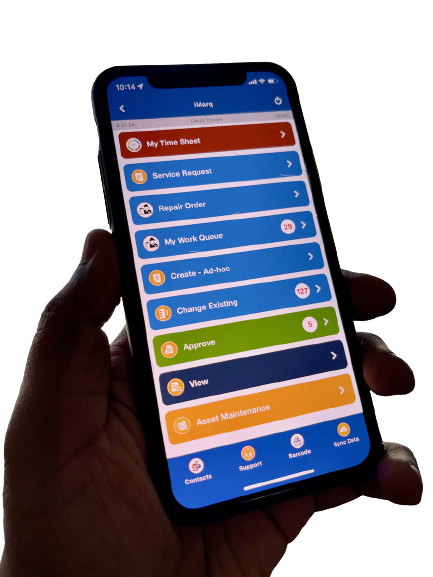
The limitations of traditional CMMS platforms don’t have to be a roadblock. Instead of replacing existing systems, organizations can enhance usability and real-time decision-making by integrating a mobile-first maintenance app like iMarq.
How a Maintenance App Bridges the CMMS Gap
Improves Technician Adoption
- iMarq’s intuitive mobile interface simplifies work order logging, inspections, and parts requests, ensuring technicians actually use the system.
- Features like barcode scanning, voice notes, and offline functionality eliminate manual data entry hurdles.
Enables Real-Time Insights Without Replacing Backend Systems
- Since iMarq integrates with any CMMS, ERP, or fleet management system, companies don’t need to overhaul their existing infrastructure.
- Real-time alerts from IoT sensors and equipment telematics can be pushed directly to technicians’ mobile devices, closing the loop between data and action.
Reduces Data Silos with Seamless Integrations
- By connecting to multiple backend systems, iMarq ensures technicians have instant access to parts inventory, repair histories, and OEM manuals—without switching between platforms.
Minimizes Alert Fatigue with Smart Notifications
- Unlike clunky CMMS interfaces, iMarq can prioritize and contextualize alerts, ensuring technicians only see what’s urgent.

The Bottom Line
Companies don’t need to abandon their CMMS investments—they need a smarter, mobile layer that makes those systems more effective. A solution like iMarq bridges the gap between complex backend software and the technicians who rely on it, transforming static data into real-time, actionable insights.
By focusing on usability rather than system replacement, companies can transform their maintenance operations. The right mobile layer makes technicians more effective while preserving current IT investments. In an industry where minutes of downtime cost thousands, this mobile-first approach turns CMMS data into immediate action.